Audit a list of bought backlinks with Python: status, noindex, X-Robots-Tag, robots.txt, canonical
A seller’s placement report proves one thing: on the day it was written, the page existed. It says nothing about whether Google may index that page, or whether the page will still be there in a year. Both questions can be answered with a short script and one request per URL, and the answers are usually worse than the report suggests.
The numbers below come from a study SpeedyIndex ran on its own orders from Fiverr and Kwork. Every URL was crawled on August 21, 2026 with a Googlebot Smartphone user agent, without following redirects, and checked for Google indexing on October 29, 2026. The script in this note repeats the crawl half of that method, so you can run it on your own list. The data is in the 15,389-link marketplace audit.
Why a status code is not enough
A year after purchase, only 562 of 15,388 links were in Google’s index: 3.7%. Live, open and indexed: 1.8%. Dead links (DNS failure, 404 or 410, parked domain, redirect to the homepage) made up 33.7%. With every blocking signal counted, 14.8% of the URLs were closed to indexing by noindex, a robots.txt Disallow or a canonical pointing elsewhere.
The figure that justifies the extra checks: 4,750 URLs answered HTTP 200, but 15.7% of those carried noindex and 32.4% had an indexing block of some kind. A page that loads in your browser can still be invisible to Google. Even among the clean pages (HTTP 200, no blocks) only 8.6% were indexed, which is why the last step of any audit is an index check.
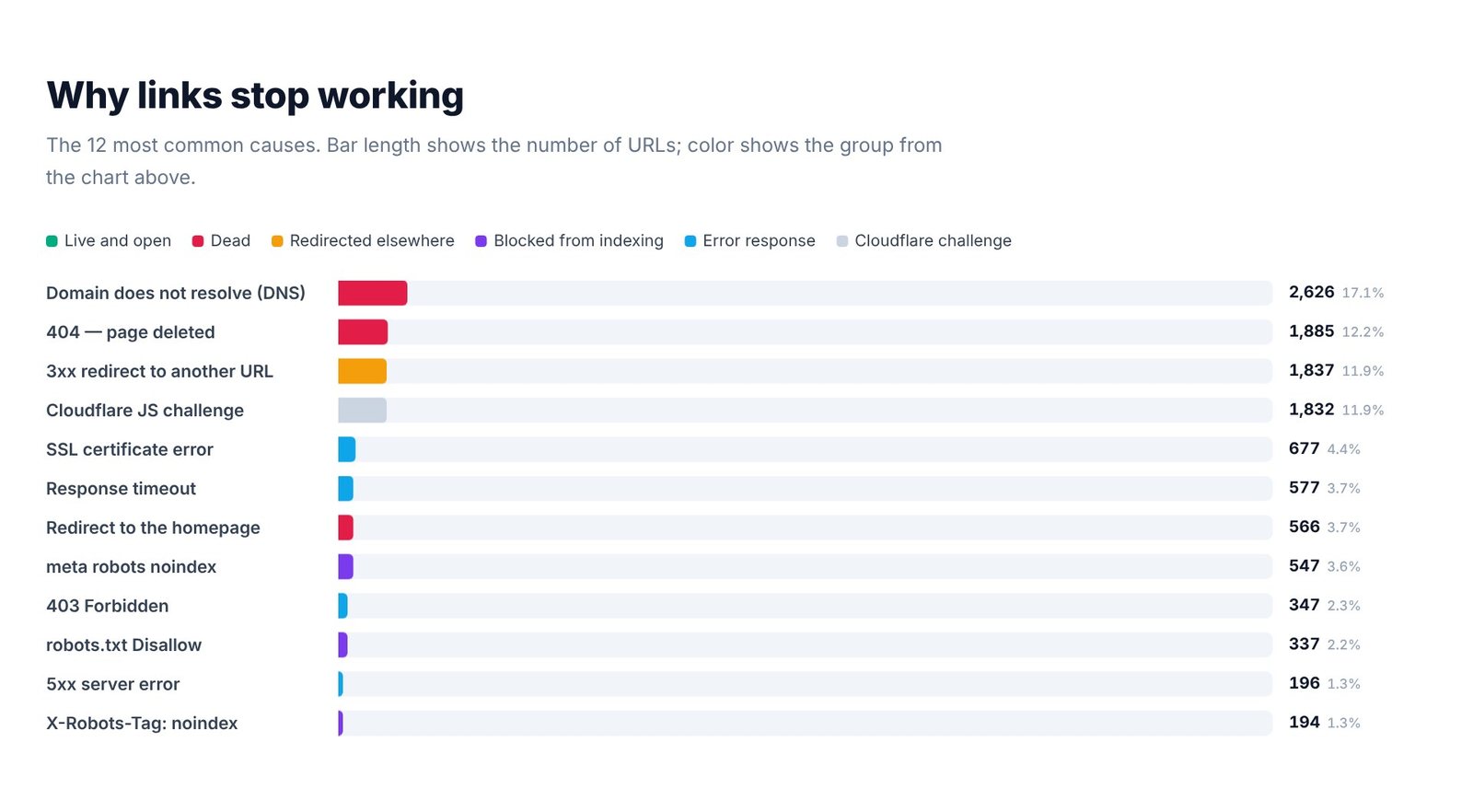 Why bought links stop working: the 12 most common causes found in the crawl of 15,389 URLs.
What the script checks
One GET request per URL, sent as Googlebot Smartphone, with redirects switched off. Each URL gets one verdict, using the same groups as the study:
- dead: the domain does not resolve, the page returns 404 or 410, or it redirects to the homepage;
- redirect: any other 301, 302, 307 or 308. The
Locationis recorded, not followed: the page you paid for is gone either way; - cloudflare_challenge: a JS challenge. It is reported as unverified, not dead, because the script does not bypass it;
- error: SSL failure, timeout, 403, 5xx and other network errors;
- blocked: HTTP 200, but at least one signal closes the page:
noindexornonein<meta name="robots">or<meta name="googlebot">, the same in anX-Robots-Tagheader (including scoped values such asgooglebot: noindex), a robots.txt Disallow for Googlebot, or arel="canonical"(HTML tag orLinkheader) pointing to a different URL; - live_open: HTTP 200 and none of the above.
The reasons column lists every signal found, so a page with both noindex and a foreign canonical shows both. If you add a target column with your domain, the script also reports whether the page still links to you and with which rel value.
The script
It needs Python 3.9+ and requests; robots.txt is parsed with urllib.robotparser from the standard library. No paid APIs.
#!/usr/bin/env python3
"""Audit a list of bought backlinks: is each page still live and open to indexing?

For every URL in the input CSV the script sends ONE request with the
Googlebot Smartphone user agent, does NOT follow redirects, and records:

  - the HTTP status and the Location header (redirects, redirects to the homepage);
  - DNS, SSL, timeout and connection failures;
  - a Cloudflare challenge (reported as unverified, not as dead);
  - noindex in <meta name="robots"> / <meta name="googlebot"> and in X-Robots-Tag;
  - a robots.txt Disallow for Googlebot (urllib.robotparser);
  - rel="canonical" (HTML tag or Link header) pointing to another URL;
  - optionally, whether the page still links to your site and with which rel.

It does not tell you whether a page is in Google's index: check that separately.

Usage:
    pip install requests
    python bought_backlink_audit.py links.csv report.csv [--workers 8] [--timeout 20]

Input CSV: a `url` column (required) and an optional `target` column with the
domain or URL the bought link should point to (e.g. example.com).
"""
import argparse
import csv
import sys
from collections import Counter
from concurrent.futures import ThreadPoolExecutor
from html.parser import HTMLParser
from threading import Lock
from urllib.parse import urljoin, urlsplit
from urllib.robotparser import RobotFileParser

import requests

UA = ("Mozilla/5.0 (Linux; Android 6.0.1; Nexus 5X Build/MMB29P) AppleWebKit/537.36 "
      "(KHTML, like Gecko) Chrome/131.0.6778.139 Mobile Safari/537.36 "
      "(compatible; Googlebot/2.1; +http://www.google.com/bot.html)")
MAX_BODY = 2_000_000  # bytes of HTML to read per page
FIELDS = ["url", "verdict", "reasons", "status", "location", "x_robots_tag",
          "meta_robots", "canonical", "robots_txt", "link_found", "link_rel", "error"]
DIRECTIVES = {"all", "index", "follow", "noindex", "nofollow", "none", "nosnippet",
              "noarchive", "nocache", "notranslate", "noimageindex", "indexifembedded",
              "unavailable_after", "max-snippet", "max-image-preview", "max-video-preview"}
DNS_ERRORS = ("NameResolutionError", "Name or service not known", "nodename nor servname",
              "getaddrinfo failed", "No address associated", "Temporary failure in name resolution")


def robots_directives(value, bot="googlebot"):
    """Directives from a robots meta `content` or one X-Robots-Tag value that apply to `bot`.

    Handles user-agent scoped values such as "googlebot: noindex" and
    "bingbot: noindex, googlebot: nofollow".
    """
    found, scope = set(), None
    for part in value.split(","):
        part = part.strip().lower()
        head, sep, rest = part.partition(":")
        if sep and head.strip() not in DIRECTIVES:  # a user-agent prefix
            scope, part = head.strip(), rest.strip()
        if part and scope in (None, bot):
            found.add(part.split(":")[0].strip())
    return found


def is_noindex(directives):
    return bool(directives & {"noindex", "none"})


class PageParser(HTMLParser):
    """Collects robots meta tags, the first rel=canonical and links to `target`."""

    def __init__(self, target=""):
        super().__init__(convert_charrefs=True)
        self.meta, self.canonical, self.rels = [], "", []
        self.target = target.lower()

    def handle_starttag(self, tag, attrs):
        a = {k.lower(): (v or "") for k, v in attrs}
        rel = a.get("rel", "").lower().split()
        if tag == "meta" and a.get("name", "").lower() in ("robots", "googlebot"):
            self.meta.append(a.get("content", ""))
        elif tag == "link" and "canonical" in rel and not self.canonical:
            self.canonical = a.get("href", "").strip()
        elif tag == "a" and self.target and self.target in a.get("href", "").lower():
            self.rels.append(" ".join(rel) or "(none)")


def norm(url):
    p = urlsplit(url)
    host = p.netloc.lower()
    for port in (":443", ":80"):
        host = host.removesuffix(port)
    return p.scheme.lower(), host, p.path or "/", p.query


def is_homepage_redirect(url, location):
    dest = urlsplit(urljoin(url, location))
    return dest.path in ("", "/") and not dest.query and urlsplit(url).path not in ("", "/")


def is_cloudflare_challenge(resp, body):
    if resp.headers.get("cf-mitigated", "").lower() == "challenge":
        return True
    return (resp.status_code in (403, 503)
            and "cloudflare" in resp.headers.get("server", "").lower()
            and ("challenge-platform" in body or "Just a moment" in body))


_robots, _robots_lock = {}, Lock()


def robots_txt(url, session, timeout):
    """'allowed', 'disallowed' or 'unknown' (robots.txt unreachable or 5xx) for Googlebot."""
    p = urlsplit(url)
    base = f"{p.scheme}://{p.netloc}"
    with _robots_lock:
        parser = _robots.get(base)
    if parser is None:
        try:
            r = session.get(base + "/robots.txt", timeout=timeout)
            if r.status_code >= 500:
                parser = "unknown"
            else:  # a 4xx means "no robots.txt": everything is allowed
                parser = RobotFileParser()
                parser.parse(r.text.splitlines() if r.status_code == 200 else [])
        except requests.RequestException:
            parser = "unknown"
        with _robots_lock:
            _robots[base] = parser
    if parser == "unknown":
        return "unknown"
    return "allowed" if parser.can_fetch("Googlebot", url) else "disallowed"


def check(row, session, timeout):
    url, target = row["url"].strip(), (row.get("target") or "").strip()
    out = dict.fromkeys(FIELDS, "")
    out["url"] = url

    def done(verdict, reasons="", error=""):
        out.update(verdict=verdict, reasons=reasons, error=str(error)[:300])
        return out

    try:
        resp = session.get(url, timeout=timeout, allow_redirects=False, stream=True)
    except requests.exceptions.SSLError as exc:
        return done("error", "ssl_error", exc)
    except requests.exceptions.Timeout as exc:
        return done("error", "timeout", exc)
    except requests.exceptions.ConnectionError as exc:
        if any(s in str(exc) for s in DNS_ERRORS):
            return done("dead", "dns_error", exc)
        return done("error", "connection_error", exc)
    except requests.RequestException as exc:
        return done("error", "request_error", exc)

    status = resp.status_code
    out["status"] = status
    raw = b""
    if status in (200, 403, 503):
        try:
            for chunk in resp.iter_content(65536):
                raw += chunk
                if len(raw) > MAX_BODY:
                    break
        except requests.RequestException as exc:
            resp.close()
            return done("error", "read_error", exc)
    resp.close()
    try:
        body = raw.decode(resp.encoding or "utf-8", errors="replace")
    except LookupError:
        body = raw.decode("utf-8", errors="replace")

    if is_cloudflare_challenge(resp, body):
        return done("cloudflare_challenge", "unverified")
    if 300 <= status < 400:
        out["location"] = resp.headers.get("location", "")
        if is_homepage_redirect(url, out["location"]):
            return done("dead", "redirect_to_homepage")
        return done("redirect", f"http_{status}")
    if status in (404, 410):
        return done("dead", f"http_{status}")
    if status != 200:
        return done("error", f"http_{status}")

    reasons = []
    header_values = resp.raw.headers.getlist("X-Robots-Tag")  # one entry per header line
    out["x_robots_tag"] = " | ".join(header_values)
    if any(is_noindex(robots_directives(v)) for v in header_values):
        reasons.append("x_robots_tag_noindex")

    page = PageParser(target)
    try:
        page.feed(body)
    except Exception:  # broken markup: keep what was parsed so far
        pass
    out["meta_robots"] = " | ".join(page.meta)
    if any(is_noindex(robots_directives(v)) for v in page.meta):
        reasons.append("meta_noindex")

    out["robots_txt"] = robots_txt(url, session, timeout)
    if out["robots_txt"] == "disallowed":
        reasons.append("robots_txt_disallow")

    canonical = page.canonical or resp.links.get("canonical", {}).get("url", "")
    if canonical:
        out["canonical"] = urljoin(url, canonical)
        if norm(out["canonical"]) != norm(url):
            reasons.append("canonical_elsewhere")

    if target:
        out["link_found"] = "yes" if page.rels else "no"
        out["link_rel"] = ";".join(sorted(set(page.rels)))
    return done("blocked" if reasons else "live_open", ";".join(reasons))


def main():
    ap = argparse.ArgumentParser(description="Check whether bought backlinks are live and indexable.")
    ap.add_argument("input", help="CSV with a 'url' column and an optional 'target' column")
    ap.add_argument("output", help="CSV report to write")
    ap.add_argument("--workers", type=int, default=8, help="parallel requests (default 8)")
    ap.add_argument("--timeout", type=float, default=20, help="seconds per request (default 20)")
    args = ap.parse_args()

    with open(args.input, newline="", encoding="utf-8-sig") as f:
        reader = csv.DictReader(f)
        if "url" not in (reader.fieldnames or []):
            sys.exit("Input CSV needs a 'url' column.")
        rows = [r for r in reader if (r.get("url") or "").strip()]

    session = requests.Session()
    session.headers.update({"User-Agent": UA, "Accept-Language": "en-US,en;q=0.9",
                            "Accept": "text/html,application/xhtml+xml,*/*;q=0.8"})
    adapter = requests.adapters.HTTPAdapter(pool_connections=args.workers, pool_maxsize=args.workers)
    session.mount("http://", adapter)
    session.mount("https://", adapter)

    counts = Counter()
    with open(args.output, "w", newline="", encoding="utf-8") as f, \
            ThreadPoolExecutor(max_workers=args.workers) as pool:
        writer = csv.DictWriter(f, fieldnames=FIELDS)
        writer.writeheader()
        for result in pool.map(lambda r: check(r, session, args.timeout), rows):
            writer.writerow(result)
            f.flush()
            counts[result["verdict"]] += 1

    total = sum(counts.values()) or 1
    for verdict, n in counts.most_common():
        print(f"{verdict:22} {n:6}  {n / total:6.1%}")


if __name__ == "__main__":
    main()
Running it
Put the URLs from the seller’s report into a CSV. The target column is optional:
url,target
https://some-web20-site.example/my-post/,yoursite.com
https://forum.example/profile/12345,yoursite.com
Then run:
pip install requests
python bought_backlink_audit.py links.csv report.csv --workers 8
The script writes one row per URL as it goes and prints a summary when it finishes:
live_open                   2   50.0%
blocked                     1   25.0%
redirect                    1   25.0%
That is the output of a four-URL test run, shown only for the format. The report has the columns url, verdict, reasons, status, location, x_robots_tag, meta_robots, canonical, robots_txt, link_found, link_rel, error.
Reading the report
- dead: write it off. In the study, 24.9% of links aged 6 to 12 months returned 404, against 10.8% of links older than a year. DNS failures went the other way: 2.3% against 18.5%. Pages get deleted in the first months; later, domains that nobody renewed take every link with them.
- redirect: open the
location. A redirect to another page on the same site may be a site restructure; a redirect elsewhere is a different page from the one in the report. - blocked: look at
reasons.meta_noindexandx_robots_tag_noindexare the platform’s choice, and the study found 457 blocked page types on 443 sites, still sold in packages. User profiles on trello.com, for example, are blocked by robots.txt and meta noindex while the homepage is open. - error and cloudflare_challenge: re-run later or check by hand before drawing conclusions.
- live_open: only these rows are worth an index check. Run them through site: and URL queries or any bulk index checker; this script does not touch Google.
Keep the report and re-run the same file at 3, 6 and 12 months. Links die gradually, and the dates tell you which seller’s packages decay fastest.
Limits of a do-it-yourself crawl
- The study crawler used a Chrome TLS fingerprint;
requestsdoes not. Some sites answer a Python client with a 403 or a challenge where a browser would get the page. - Not every bot challenge is a Cloudflare 403. While testing this script, a CDN challenge on another site came back as a plain HTTP 200 page. If you pass
targetand alive_openrow showslink_found = no, open that page by hand. urllib.robotparserapplies rules in file order, not with Google’s longest-match precedence, so a file that mixesAllowandDisallowfor the same path can be misread. Ifrobots_txtisdisallowedon a URL that matters, confirm it against the file.- Parked domains that still answer 200 are not detected, and noindex added by JavaScript is invisible to a plain HTTP client.
- One crawl is one date. The study had the same limit: one crawl date, one index-check date, orders from one buyer. It did not bypass the Cloudflare challenge either, so 1,832 URLs were counted as unverified rather than dead.
Before you buy the next package
Google’s spam policies list buying or selling links for ranking purposes as link spam; such links are not a violation as long as they carry rel="nofollow" or rel="sponsored". The link_rel column shows what the seller actually placed. The study adds a practical argument to the policy one: a year later, most of what was paid for no longer works. Run the script on the seller’s sample report before you pay, not after.